Grappling with AI's Labor Impact (Updated)
Like everyone else I’ve been trying to understand the impact of AI on the job market. Calling the current state of things ‘murky’ is a understatement. Things are moving fast. It seems new models and products like Anthropic’s Mythos and Claude Design dramatically reshape the landscape every week or two promising more capabilities and likely more job automation. At the same time there’s polls showing bipartisan support for data center construction moratoriums. Then there’s Microsoft’s recent announcement they are pausing Copilot sign-ups for single-user plans which suggests even the hyperscalers are struggling with AI’s economics.
In other words, one side indicates a continued expansion of AI capabilities at roughly the same pace we’re experiencing now. The other side seems to give the first indications that economic and capacity constraints are about to kick in raising costs and putting a damper on AI adoption. It’s genuinely hard to say how this will all turn out but a couple of items I came acorss recently have helped me think more clearly about AI and its near-term impacts: results from the Richmond Fed’s most recent CFO survey and an academic paper analyzing the market dynamics of AI adoption.
CFO Survey
The Atlanta and Richmond Federal Reserve Banks conduct a survey of CFOs every quarter to better understand market conditions and learn about business leaders’ challenges and expectations for the economy. It doesn’t seem to get a lot of attention from non-banking and econ folks which I think is a real shame. The survey contains a lot of good information that’s hard to find elsewhere.
The results published on March 25 have a whole section dedicated to AI. Some of the information is quite eye opening.
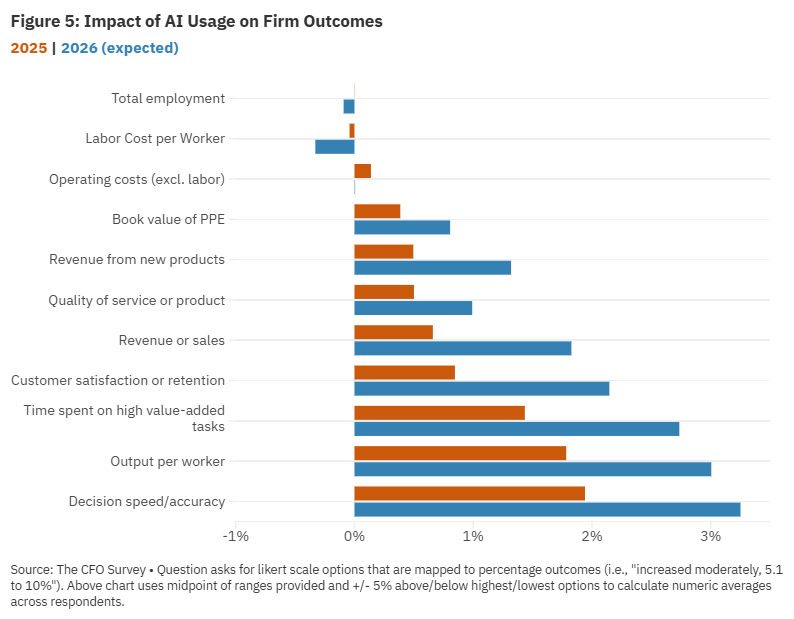
Both total employment and cost per worker are expected to decrease in 2026. In fact, cost per worker is expected to decrease more than total employment which suggests:
- Workforce composition shifting towards more junior or otherwise cheaper roles
- Compensation compression through reduced bonuses, smaller raises, or trimmed benefits
- CFOs pricing in a softer labor market that gives employers more leverage on new-hire comp
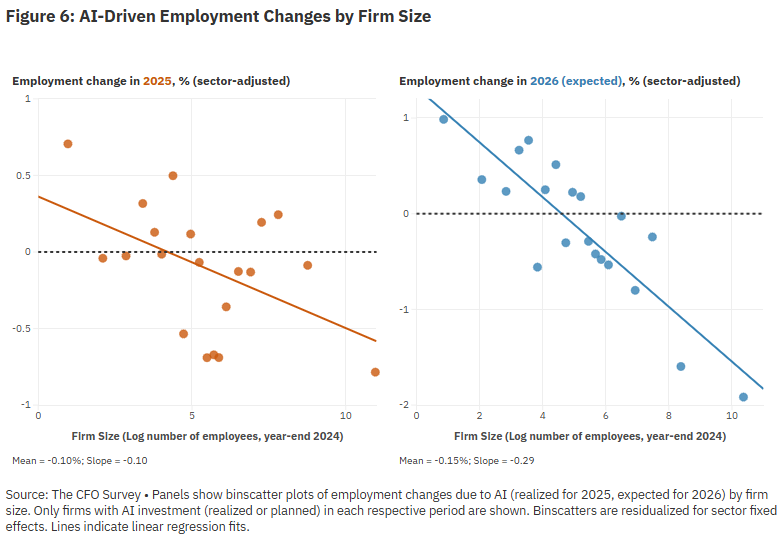
This graph is the one I struggle with the most. The survey results describe the data as “firms have not decreased their headcounts due to the incorporation of AI — nor do they plan to decrease them in the near term” which I can’t square with the number of data points below the zero line. The log-scale x-axis also flattens the difference between small and large firms, hiding how many people are actually affected. Laying off 1% of 500 employees is very different from laying off 1% of 50,000.
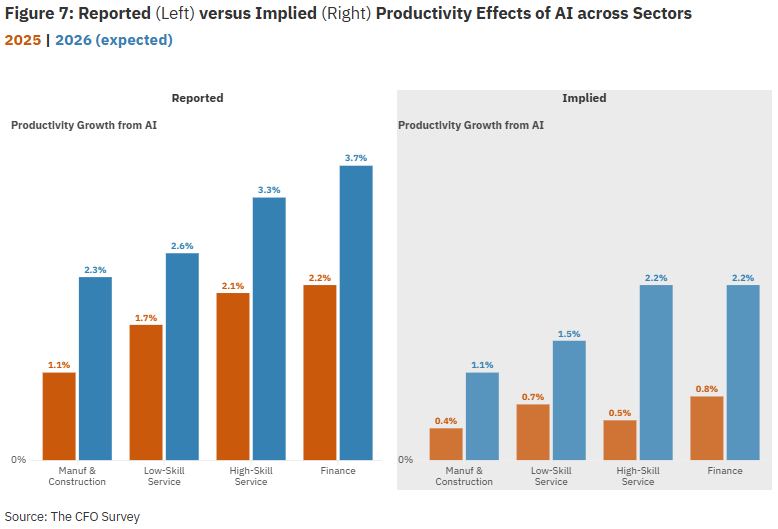
These two graphs show a pretty big disconnect between perceived and actual productivity gains. The gap between perception and reality could explain why there’s so much pressure on employees to adopt AI. Managers are chasing productivity gains based on miscalibrated expectations. I can think of at least three reasons why this would happen:
- Inherent difficulty of measuring knowledge work productivity
- Expectations anchored to vendor marketing
- Survivorship bias of successful AI projects
tl;dr
I expect hiring will continue to be slow and the job market will tighten for the rest of the year.
The AI Layoff Trap
[5/1/2026 update: I’ve built an interactive version of the paper available here.]
The offshoring wave of the 1990s and early 2000s has a shape worth remembering. When a firm moved manufacturing or a call center overseas, the labor arbitrage landed directly on its own books. The hollowing out of domestic purchasing power and industrial capacity was diffuse enough that no single firm had to bear the full cost of it. The bill came due as a generation of wage stagnation in the affected sectors and a political backlash still reshaping trade policy today.
A recent paper by Falk and Tsoukalas argues AI automation is the same mechanism, running faster and across a wider slice of the labor market.
The intuition: workers are also customers. When a firm replaces workers with AI, it captures the labor savings directly and immediately. The lost spending from the people it just let go doesn’t land anywhere in particular — it spreads thinly across every firm those workers used to buy from. No single firm feels enough of the demand hit to reconsider, so every firm keeps automating. Each decision is individually rational. The aggregate result is that firms collectively shrink the market they’re all selling into.
Economists call this an externality. It’s the same structural problem as pollution: the party making the decision captures the benefit, and the cost is socialized. No firm acting alone has an incentive to change course, because unilaterally holding back just means losing ground to competitors who won’t.
Falk and Tsoukalas formalize this with a game-theoretic model and derive what a corrective tax on automation would have to look like. The math isn’t light reading, so I built an interactive explainer that walks through the mechanism with adjustable parameters. This will be launching soon.
This reframes the CFO data. Firms aren’t miscalculating. Each one is responding correctly to the incentives it faces. The incentives themselves are misaligned with the aggregate outcome — which is the textbook condition for market failure.
Comments